Introduction
Most crypto investors are chasing high returns but losing sleep over unstable income. That’s the reality of today’s market.
According to industry trends, DeFi yields can fluctuate by 50% or more within weeks, making it hard for investors to rely on consistent earnings. This is exactly why the discussion around CoinLander vs DeFi Lending is growing fast, especially among investors looking for stability instead of constant risk.
The global market for tokenized real estate is growing rapidly, with projections estimating it could reach $4 trillion by 2035. This shows why investors are increasingly looking at stable, real-world-backed crypto options like CoinLander.
In simple terms, this comparison is about two different approaches to earning in crypto. One is fast-moving and unpredictable, while the other is steady and backed by real-world assets.
In this article, we’ll break down CoinLander vs DeFi Lending, compare 6–12% APR from tokenized mortgages with yields from DeFi lending platforms, and explain which option is better for stability, passive income, and long-term growth.
What is CoinLander?
CoinLander is a platform that connects crypto investing with real estate.
Instead of lending your money to crypto traders, CoinLander allows you to invest in tokenized mortgages. This means your money is used in real property loans, and you earn returns from mortgage payments.
How CoinLander works:
- Real estate loans are converted into digital tokens
- Investors buy these tokens
- Borrowers repay loans with interest
- Investors earn a share of that interest
Why this matters:
- Your investment is backed by physical property
- Returns are more predictable
- Risk is linked to real-world assets, not just crypto
This is why many people call it real estate-backed crypto.
What is DeFi Lending?
DeFi lending platforms are part of decentralized finance. They allow users to lend and borrow crypto without banks.
How DeFi lending works:
- You deposit crypto (like ETH or USDC)
- Borrowers take loans using crypto as collateral
- You earn interest from those loans
Popular platforms include Aave and Yearn.
Key features of DeFi lending:
- No middleman (fully decentralized)
- Flexible deposits and withdrawals
- Interest rates change based on demand
The downside:
- Yields are not stable
- Returns depend on market activity
- High volatility can affect your earnings
This is where the debate of CoinLander vs DeFi Lending becomes important.
CoinLander vs DeFi Lending (Core Comparison)
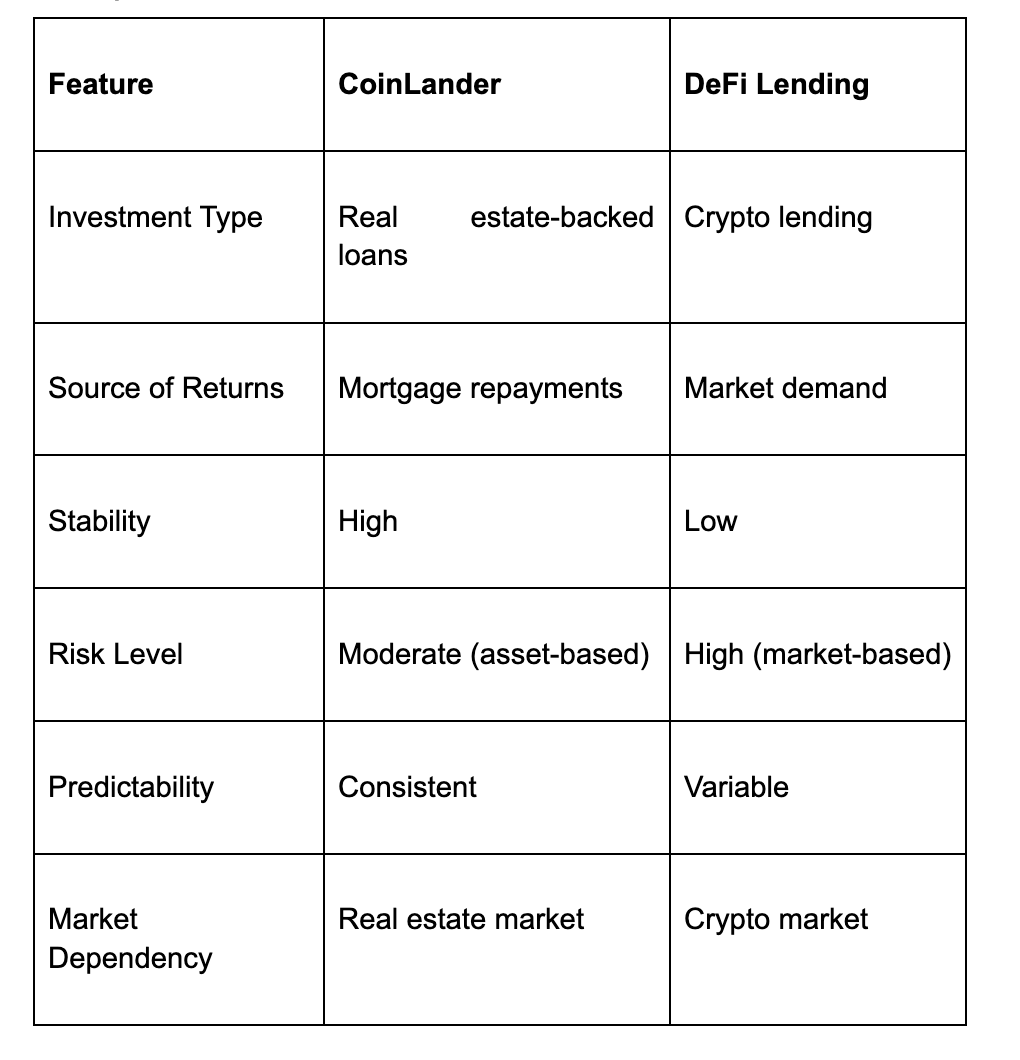
When comparing CoinLander vs DeFi Lending, the main difference lies in how returns are generated and what backs your investment. DeFi lending operates entirely within the crypto ecosystem, where users lend digital assets and earn interest based on market demand, which makes returns highly variable.
In contrast, CoinLander connects crypto with real-world assets by offering investments in real estate-backed loans through tokenized mortgages, where returns come from structured mortgage repayments. This makes income more predictable and less affected by crypto market volatility.
Because of this, DeFi offers flexibility but comes with higher uncertainty, while CoinLander provides more stability and consistent returns over time.
Comparison Table
APR Comparison: 6–12% vs Variable Yields
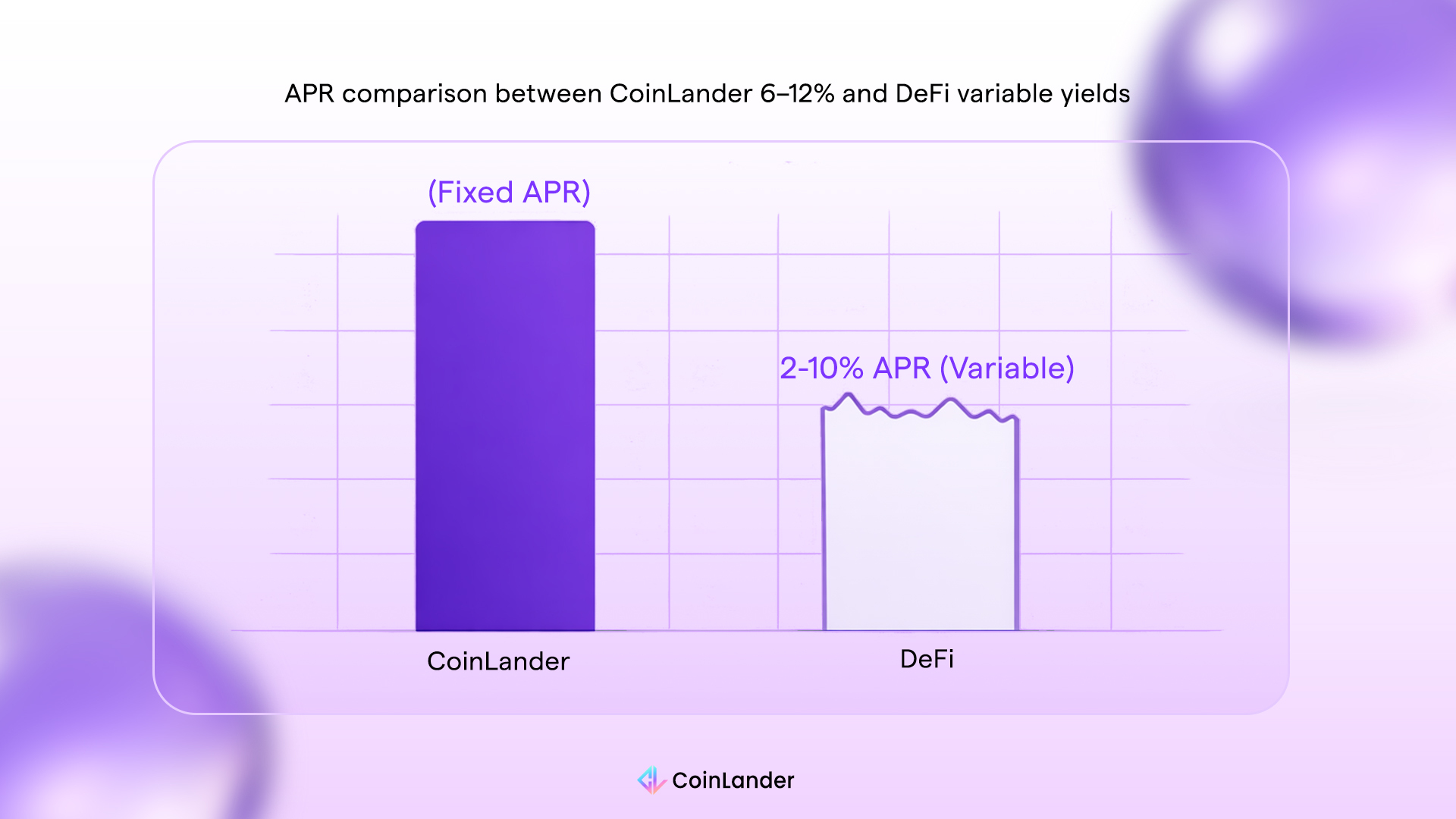
When evaluating CoinLander vs DeFi Lending, one of the most important factors for investors is the potential returns, usually measured as APR (Annual Percentage Rate). CoinLander offers 6–12% APR through tokenized mortgages, where your returns come from borrowers repaying real estate-backed loans. Because these payments are structured, the APR tends to be relatively stable, giving investors predictable income over time.
On the other hand, DeFi lending platforms like Aave or Yearn can offer 2–10% APR or even higher on certain assets. However, these rates fluctuate frequently based on market demand, liquidity, and crypto price movements. While DeFi can sometimes provide higher short-term returns, the unpredictable nature of the APR makes long-term planning difficult.
This comparison highlights why stability matters: a consistent APR from CoinLander allows investors to plan and grow their portfolio steadily, while variable DeFi yields are better suited for those willing to accept higher risk for potentially higher rewards. In terms of predictable income and lower stress, CoinLander clearly has the advantage.
Stability: Real Estate vs Crypto Volatility
When comparing CoinLander vs DeFi Lending, stability is one of the most important factors that sets them apart.
DeFi Lending Stability
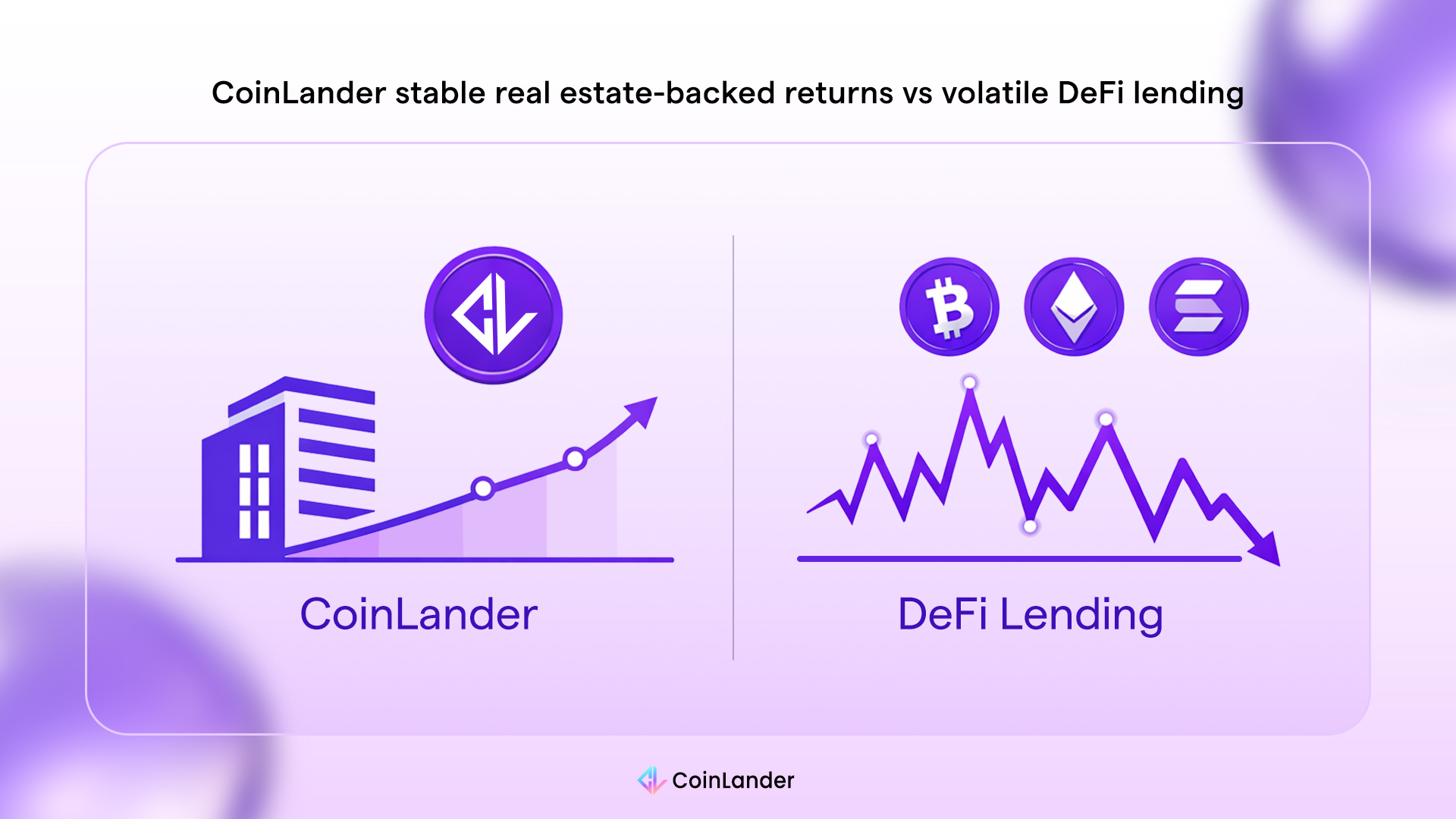
DeFi lending platforms depend entirely on crypto markets. Your returns fluctuate with crypto prices and can be affected by sudden market crashes. This means yields can drop unexpectedly, making long-term income planning difficult.
CoinLander Stability
CoinLander, on the other hand, is backed by real estate. Returns come from long-term mortgage repayments, which are structured and predictable. Because the investment is tied to physical property, it is far less affected by crypto price swings or market volatility.
Explanation Through Simple Example
If the crypto market crashes, DeFi yields may drop dramatically overnight. Meanwhile, loans backed by real estate continue generating repayments, keeping CoinLander returns steady.
This illustrates why investors seeking predictable and stable income often prefer CoinLander over traditional DeFi lending platforms.
Investment Risks in CoinLander vs DeFi Lending: Which Is Safer?
Every investment carries some level of risk, but the type and predictability of that risk can vary significantly between CoinLander vs DeFi Lending.
DeFi Lending Risks
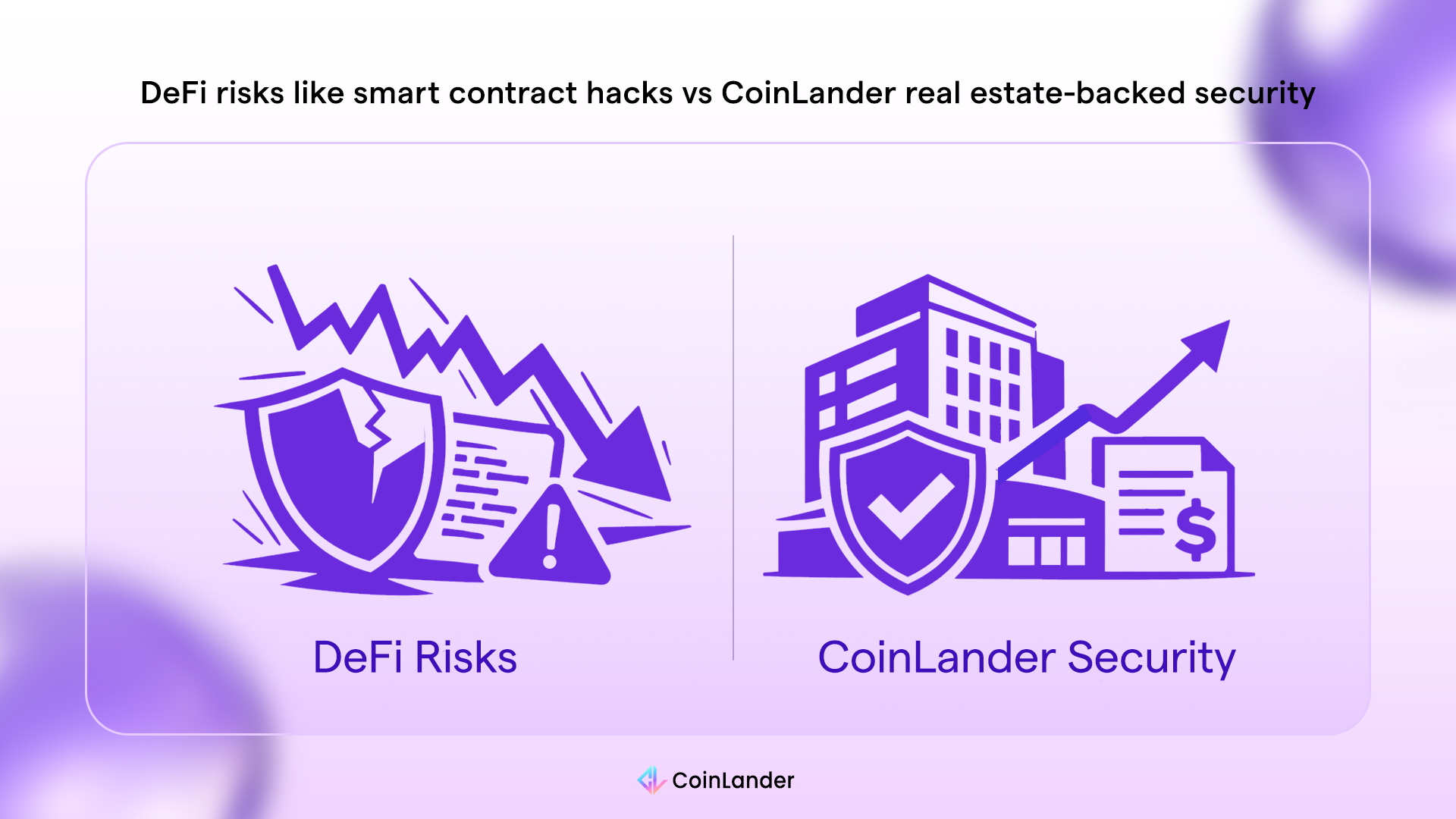
DeFi platforms operate entirely within the crypto ecosystem, which exposes investors to several unpredictable risks. These include smart contract vulnerabilities, sudden liquidations of collateral, and sharp market crashes that can drastically reduce returns. Because of how fast crypto markets move, these risks can occur with little warning, making DeFi investments more volatile and uncertain.
CoinLander Risks
CoinLander’s risks are tied to real-world factors. These include fluctuations in property values, potential loan defaults, and regulatory changes that may affect real estate-backed crypto investments. While risks still exist, they tend to be slower-moving and easier to anticipate or manage, offering investors more clarity and control.
Liquidity in CoinLander vs DeFi Lending: How Easily Can You Access Your Funds?
Liquidity is an important factor because it determines how quickly you can access your invested money. On DeFi lending platforms like Aave or Yearn, liquidity is very high and you can deposit or withdraw crypto almost instantly. This makes it easy to react to market changes or move funds when needed.
CoinLander works differently. Since investments are tied to real estate-backed loans, withdrawals may take longer. Some investments have lock-in periods, and full access is usually tied to the repayment schedule of the underlying mortgages. Some platforms may offer token resale options, but liquidity is generally slower compared to DeFi.
What this means for investors:
- If you need quick access to your money, DeFi is more flexible.
- If you’re comfortable holding your investment for a period to earn stable returns, CoinLander is a better choice.
The trade-off is simple: DeFi gives flexibility but higher risk, while CoinLander provides stability but requires holding your investment longer.
Beginner Friendliness: Which Platform Is Easier to Start With?
For anyone new to crypto investing, ease of use and simplicity can make all the difference. DeFi lending platforms like Aave or Yearn can feel intimidating at first. You need to set up wallets, manage private keys, pay gas fees, and constantly track changing interest rates to avoid losing out. For beginners, this level of technical detail can be overwhelming, especially if you just want a steady, passive income.
CoinLander takes a much simpler approach. Its platform is designed to be beginner-friendly, with a clean, intuitive interface that makes investing in tokenized mortgages easy. You don’t need to understand complex smart contracts or constantly monitor the crypto market to earn returns. The APR is fixed or semi-fixed, so you can see exactly what to expect from your investment over time.
Another advantage is that your investment is backed by real-world property. This makes the risks more tangible and easier to understand compared to the unpredictable swings of DeFi lending. Beginners can feel confident knowing their returns are structured and based on something concrete.
Overall, CoinLander provides an approachable way to enter the world of crypto investing. You can gradually build your portfolio, earn meaningful returns, and focus on learning the market at your own pace, without the stress of constantly reacting to volatile crypto prices. It’s a practical and safe way for new investors to start earning in crypto while keeping things simple and manageable.
Smart Portfolio Strategy: Balancing CoinLander and DeFi for Maximum Returns
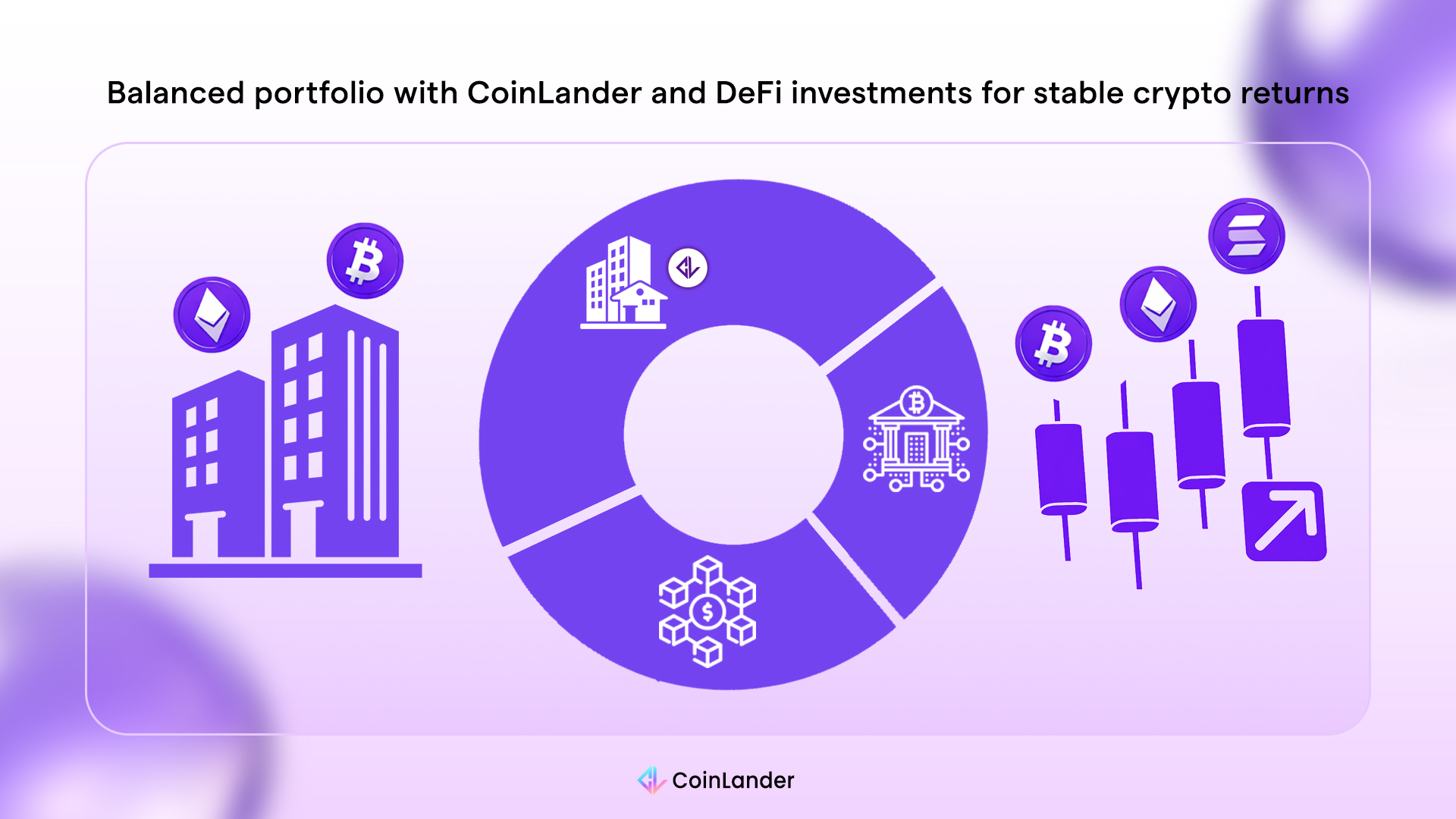
Experienced investors know that relying on a single type of investment can limit growth and increase risk. A smart strategy often involves balancing stable, predictable returns with higher-risk, high-yield opportunities. This is where combining CoinLander and DeFi platforms can be highly effective.
For example, an investor might allocate:
- 60% of their portfolio in CoinLander for stability and predictable 6–12% APR from tokenized mortgages
- 40% in DeFi lending platforms like Aave or Yearn to capitalize on variable yields and potential high short-term returns
This strategy creates a balance. CoinLander provides a solid foundation for passive income, reducing overall risk in your portfolio. Meanwhile, DeFi allows you to participate in higher-yield opportunities that, although riskier, can boost overall returns if the market performs well.
Additionally, diversifying between real-world asset-backed crypto and purely digital lending reduces exposure to any single type of market risk. Investors can benefit from the growth potential of DeFi while maintaining the stability and predictability of CoinLander, creating a portfolio that is both resilient and profitable over the long term.
The Future of Real Estate-Backed Crypto: Why Platforms Like CoinLander Are Gaining Traction
The future of crypto is not purely digital, it is increasingly connected to real-world assets. While early adoption focused purely on digital assets like Bitcoin or Ethereum, the next wave of investors is looking for real-world connections, stability, and predictable returns. This is where real estate-backed crypto, like what CoinLander offers, comes into play.
Tokenization allows traditional assets like property to be represented digitally on a blockchain. Investors can purchase small portions of real estate loans through tokens, gaining access to stable income streams that were previously limited to institutional investors. This innovation bridges the gap between conventional finance and crypto, giving retail investors opportunities to diversify safely.
Several trends are pushing real estate-backed crypto into the spotlight:
- Institutional interest is growing, with banks and investment funds exploring tokenized assets
- Improved regulations are making property-backed crypto investments safer and more transparent
- Technological advancements allow for secure, accessible platforms where investors can participate with minimal technical expertise
Platforms like CoinLander are at the forefront of this trend. By combining blockchain technology with tangible, real-world assets, they offer stability, predictability, and transparency. Investors benefit from a model that provides steady returns even in volatile crypto markets. As more people seek long-term passive income without exposure to wild crypto swings, CoinLander and similar platforms are positioned for substantial growth.
Conclusion: CoinLander vs DeFi Lending – Which Is Right for You?
The debate over CoinLander vs DeFi Lending isn’t about choosing a universally “better” platform; it’s about matching your investment goals.
- If you want high-risk, flexible returns and can tolerate volatility, DeFi lending platforms may suit you.
- If you prefer stable income, predictability, and less stress, CoinLander, with its real estate-backed model, offers a strong alternative.
For investors who value steady growth and long-term planning, CoinLander provides a unique opportunity to earn reliable returns while benefiting from the security of tangible assets.
Frequently Asked Questions
1. What is the main difference between CoinLander and DeFi lending?
CoinLander invests in real estate-backed loans, offering stable returns, while DeFi lending lets you lend crypto to other users, with returns that fluctuate based on market conditions.
2. How much APR can I expect from CoinLander vs DeFi platforms?
CoinLander offers 6–12% APR from tokenized mortgages, which is relatively stable. DeFi lending APR varies, usually 2–10%, and can change daily based on supply and demand.
3. Is CoinLander safer than DeFi lending?
Yes, CoinLander’s returns are backed by real estate, making them more predictable. DeFi carries risks like market crashes, smart contract hacks, and sudden liquidations.
4. Can I withdraw my money anytime from CoinLander?
Liquidity in CoinLander is slower because funds are tied to mortgages, sometimes with lock-in periods. DeFi allows instant withdrawals, but with higher volatility risk.
5. Which platform is better for beginners?
CoinLander is beginner-friendly, with a simple interface and predictable returns. DeFi requires technical knowledge, wallet setup, and constant monitoring, which can be overwhelming for new investors.